ColorFerm® DeltaE
Multiband spectral capture, ΔE00, statistical filtering and a trainable neural network for more consistent color decisions on the production floor.
ColorFerm DeltaE is a Spectral Audit System designed to turn color decisions into an objective, repeatable and traceable criterion. It analyzes spectral information from the visible range, processes multiple measurement inputs and applies a neural network with two hidden layers of 64 neurons to help interpret the result within the real production process.
It does not simply display data: it turns the measurement into a practical decision for production and quality teams.
The AI learns from real calibrations and standards to adjust ΔE00 interpretation to real materials, finishes and production conditions. Less uncertainty, more repeatable criteria.
What ColorFerm adds beyond measurement
It does not stop at LAB or ΔE00 values: it brings interpretation, decision support and traceability into a single workflow.
It interprets, not just reports
The result is not just a set of numbers: ColorFerm turns the measurement into a useful production output using PASS, WARNING or FAIL states.
It learns from the real process
Interpretation improves with the customer's own calibrations, references and real samples, adapting to materials, finishes and actual conditions of use.
It turns use into a company asset
Records, profiles, references and history help build an internal knowledge base instead of relying only on individual operator experience.
Who it is designed for
ColorFerm DeltaE is aimed at environments where industrial color control must be fast, repeatable and easy to interpret in production.
Quality managers
For teams that need an objective and traceable criterion for acceptance, rejection and monitoring of color deviations.
Industrial production
For processes where the operator needs a clear answer on the production floor without complex laboratory procedures.
Color-critical processes
Especially useful in coatings, plastics, textiles and other applications where small tonal deviations have real impact.
Companies seeking fewer rejects
Designed to standardize decisions, reduce rework and improve consistency in color quality control.
What is ColorFerm® DeltaE?
It is a Spectral Audit System designed for the production floor, not only for the laboratory. Its value lies in measuring with criteria, interpreting in context and helping teams decide with traceability.
From “it looks right” to measurable data
Each measurement provides CIELAB values and a ΔE00 against the reference standard, allowing a clear decision on whether a part is inside or outside tolerance.
Learning from your own standards
The AI model is trained with your standards and acceptance/rejection decisions, progressively refining ΔE00 interpretation for your production reality.
Fast, guided and robust
Quick guides, automatic warnings and simplified workflows allow any operator to use the system safely after brief training.
Benefits for your company
A single device to reduce subjectivity, speed up decisions and build repeatable criteria through daily use.
Fewer subjective decisions
Defining and respecting ΔE00 limits reduces out-of-spec output and minimizes discussions based only on visual perception.
Faster acceptance or rejection
The combination of measurement, interpretation and visual states speeds up production decisions without relying on complex tables or later reviews.
More value over time
Every calibration, reference and historical record strengthens an internal knowledge base that improves process consistency.
The problem it solves
It turns a visual and debatable criterion into an objective, repeatable and documentable decision.
Decision variability
Visual control creates differences between shifts, operators and lighting conditions. The same part can look acceptable to one person and unacceptable to another.
An objective and repeatable criterion
ColorFerm DeltaE turns visual perception into a data-driven decision: CIELAB values, ΔE00 and PASS / WARNING / FAIL states for fast action.
Fewer rejects and rework
By reducing subjectivity, it improves color quality-control consistency and reduces deviations that end up causing late corrections.
Fast decisions without complexity
The system is designed for operators and quality managers who need a clear answer without complex laboratory procedures.
ColorFerm AI and technology
Visible spectral capture, multivariable processing, guided calibration and a trainable architecture to turn measurement into a practical production tool.
Multiband capture in the visible range
ColorFerm works with spectral information from the visible range, approximately 415 to 680 nm, and combines it with auxiliary variables to build a richer input than a minimal measurement.
Two hidden layers of 64 neurons
The neural network receives multiple measurement-system inputs and processes them through two hidden layers of 64 neurons to help interpret color according to the customer's references, finishes and real standards.
More stability than minimum calibration
In addition to basic calibration, the system can work with intermediate points to improve stability, consistency and sensitivity when the process requires finer control.
It does not just show data: it makes it actionable
The measurement is translated into a useful process output through visual states, tolerances and traceability, turning the technical result into a real operating decision.
Why ColorFerm DeltaE?
A different approach to production color control: more useful than a solution limited to measuring and displaying values.
Better interpretation than a device that only reports
It does not stop at LAB or ΔE00 values: it helps interpret the result within the real process context and the tolerances defined by the company.
It learns from the customer's process
It adapts to real calibrations, references and samples to bring measurement closer to the effective behavior of the material and finish.
Easier to implement on the production floor
It is designed for operators and quality teams, with direct readings and a usage logic that does not force production to work like a laboratory.
It builds criteria and traceability over time
Profiles, records, references and histories turn daily use into an internal company knowledge base.
Designed to provide a clear industrial advantage
It is not just a measuring device: it is a decision tool for production, quality and continuous process improvement.
Measures with criteria
Objective color measurement based on ΔE00 and spectral processing focused on repeatability.
Interprets
The neural network helps convert several technical inputs into a more useful output for the real process.
Decides
The combination of reference, tolerance and assisted interpretation enables faster and more consistent decisions.
Documents
Records and histories provide the documentation base needed for monitoring, analysis and traceability.
Industrial applications
A device aimed at processes where color stops being a subjective impression and becomes a measurable criterion.
Paints and coatings
Fast verification of final color, batch-to-batch consistency control and reduction of rejects caused by tonal deviation.
Plastics and technical parts
Objective visual control over molded parts, colored components and finishes where repeatability is essential.
Textiles and treated surfaces
Color monitoring on materials with different finishes, supported by the calibration system and adaptive learning.
Production control
Ideal for environments where operators need a fast, clear answer without interpreting complex laboratory tables.
What ColorFerm DeltaE adds compared with a conventional colorimeter
Professional colorimeters are highly precise tools for measuring and displaying color values such as LAB or ΔE. ColorFerm DeltaE starts from that foundation, but is designed to go one step further: turning the measurement into a useful, traceable decision adapted to the real production process.
Interprets and supports decisions
A conventional colorimeter delivers technical data. ColorFerm turns that data into a direct production response through PASS / WARNING / FAIL states, helping operators act without interpreting complex tables.
Neural network trained with the customer's process
ColorFerm incorporates a trainable neural network with two hidden layers of 64 neurons, using real production samples: materials, finishes, tolerances and company-specific standards.
Multiple readings with statistical filtering
Instead of relying on a single reading, ColorFerm can take several consecutive measurements, compare repeatability and reduce the effect of abnormal readings on matte, rough, textured or variable surfaces.
Integrated traceability
Each measurement can be recorded with date, time, identified color, LAB values, ΔE, temperature and control result. This makes the system a process-monitoring tool, not just a one-off measuring instrument.
Designed for production
ColorFerm is built for use on the production floor: simple interface, clear response, visible history, guided calibration and operation adapted to non-specialist operators.
BLE connectivity and mobile app
Bluetooth connectivity allows users to view and download histories from a mobile application, making documentation, monitoring and device control easier without relying exclusively on a computer.
The key difference: ColorFerm integrates measurement, process learning, automatic decision support and traceability into a compact tool designed for production.
How it integrates into production
A clear, easy-to-implement workflow: reference, tolerance, measurement, decision and record.
Define the reference
The master sample or color standard is measured and used as the process baseline.
Define tolerance
The acceptance criterion is set using ΔE00 and limits adapted to the finish.
Measure in production
The operator measures the part directly on the production floor without complex procedures.
Decide and record
The system displays PASS / WARNING / FAIL and keeps traceability of the measurement.
How it works in practice
A realistic production workflow: capture, process and interpret with AI support.
1. Capture and calibration
Calibration with real process standards and references. Each adjustment feeds the system's criteria base and improves alignment with specific materials and finishes.
2. Multivariable processing
The measurement combines multiple readings, statistical filtering, visible spectral information and auxiliary inputs before calculating CIELAB, ΔE00 and the interpretation layer.
3. A useful result for decisions
The system returns objective values and a practical output for production and quality, with tolerances, visual states and a traceable result record.
Intelligent measurement processing
ColorFerm DeltaE is not limited to a single reading. The system applies a processing flow designed to obtain stable results even on real production surfaces.
Automatic multiple measurements
Each measurement is made up of several consecutive readings from the spectral sensor. The system analyzes stability before calculating the final result.
Statistical filtering
Filtering algorithms remove anomalous readings (outliers), increasing repeatability on matte, rough or slightly variable surfaces.
Spectral normalization
Spectral sensor values are normalized before feeding the calculation model, reducing the influence of lighting or reflectance variations.
Trainable neural network
The final color calculation uses a neural network that learns from the user's real calibrations.
Automatic PASS / FAIL decision
The system compares the obtained ΔE00 with the limits defined by the production process and automatically displays whether the part meets tolerance.
Tolerances by finish type
Different tolerances can be defined for matte, glossy or rough finishes, adapting color quality control to the real product.
Measurement traceability
The system does not just measure: it also documents the process for monitoring, analysis and continuous improvement.
Result records
Each measurement can be recorded for later analysis, quality review and historical monitoring of color deviations.
Calibration history
System calibrations and adjustments become part of a useful knowledge base that helps maintain consistency in industrial color control.
Process monitoring
Traceability makes it easier to identify trends, detect unwanted color changes and act before they become rejects or returns.
Ready for analysis
Data can be used to evaluate stability, compare batches and strengthen color quality control over time.
ColorFerm system architecture
An architecture designed to turn a complex measurement into a practical production decision.
Visual diagram of the ColorFerm architecture
Controlled illumination and multichannel spectral sensor.
Multi-measurement statistical filtering, CIELAB and ΔE00 evaluation.
Adaptive neural network trained with real calibrations.
Immediate result: PASS, WARNING or FAIL.
Optical capture
Multichannel spectral sensor and controlled RGBW illumination for stable readings adapted to the measurement environment.
Processing
Statistical filtering, CIELAB calculation and ΔE00 evaluation to transform captured signals into a technically interpretable result.
Learning
Trainable neural network and adaptive logic to adjust color interpretation to real calibrations and process references.
Impact on production costs
Industrial color control does not only improve quality: it also helps reduce hidden process costs.
Less rework
Detecting tonal deviation earlier reduces late corrections and reprocessing work.
Fewer rejects
Objective evaluation reduces the chance of accepting out-of-criterion parts or rejecting correct parts based only on visual perception.
Fewer returns
A more consistent color decision helps avoid customer disagreements and batch-to-batch deviations.
More consistency between shifts
A common criterion improves color quality-control stability across different people, lines and production times.
Safety and responsible use
ColorFerm DeltaE is designed for safe use in industrial environments. Even so, basic rules must be followed.
Good operating practices
- Use only standards supplied or validated by Quality.
- Keep standards and the optical window clean to avoid reading errors.
- Do not force the cover or use parts that may scratch or damage the interior.
- Follow internal lockout/tagout procedures if the device requires maintenance.
Limitations and warnings
- It is not explosion-proof and is not designed for ATEX atmospheres.
- It is not intended for medical, critical pharmaceutical or legal metrology use.
- Advanced AI settings must be defined by Quality personnel.
- Final interpretation of results always belongs to the Quality manager.
Images and videos
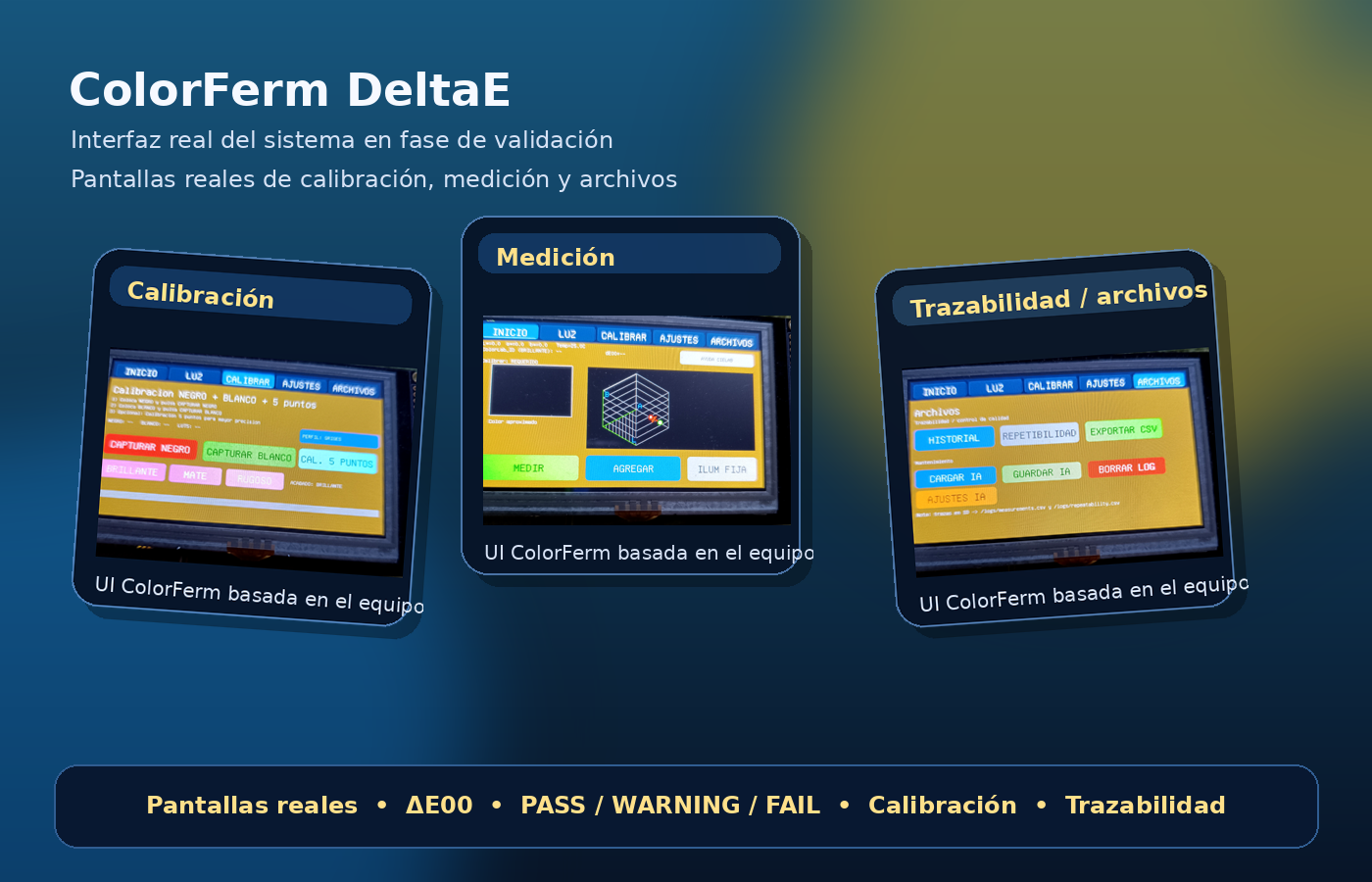
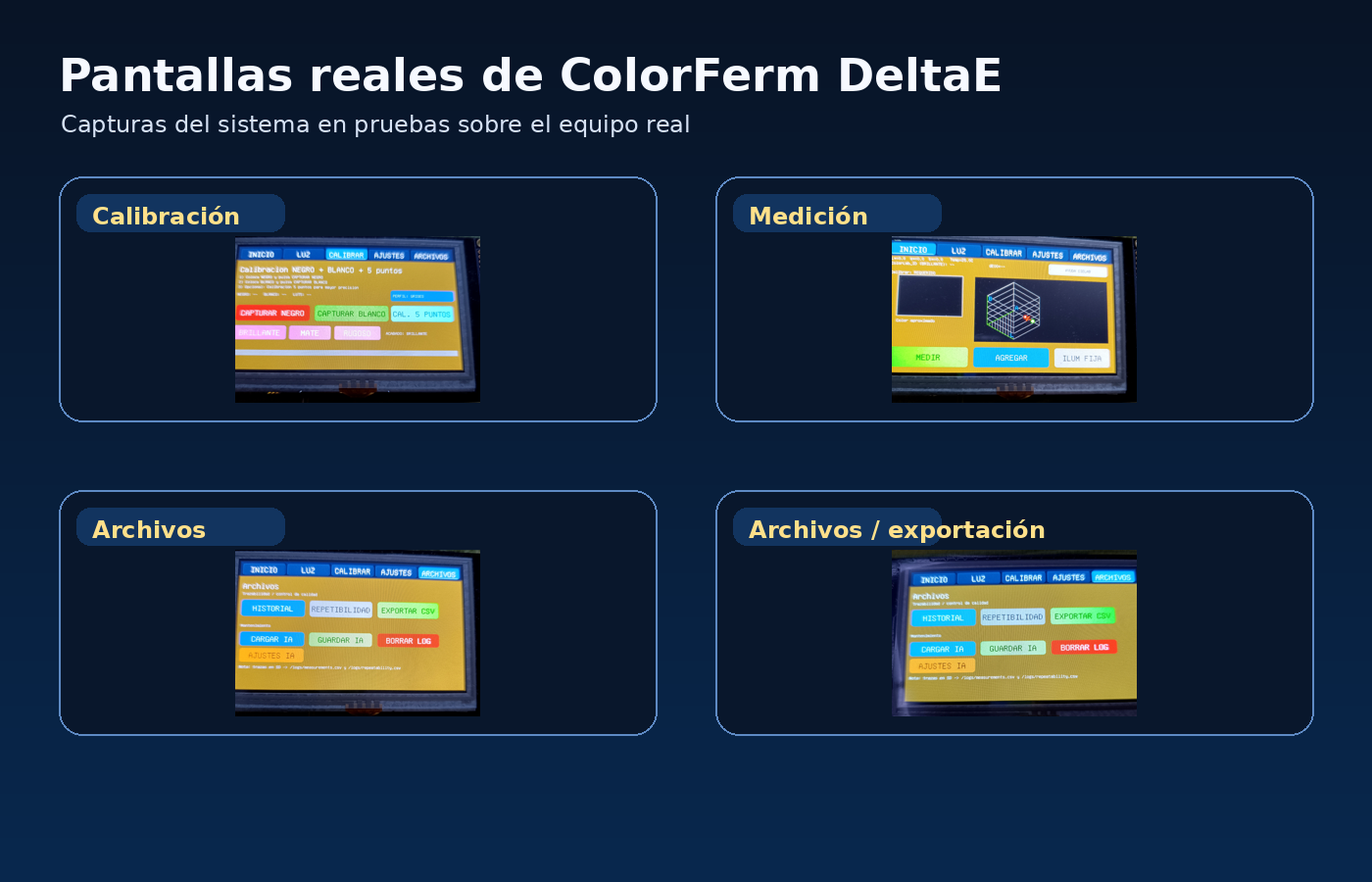
Real captures of the ColorFerm DeltaE system during validation, together with space for future images of the final device and production-use videos.
Cover of the ColorFerm DeltaE system user manual
ColorFerm BLE mobile app
This page includes a real capture of the application with its current name visible on screen: ColorFerm BLE. The app enables BLE connection with the device, authentication and access to functions such as help, device information, history download, repeated measurements and system log.
Real application interface
The capture shows the current app name, BLE module connection, authentication status and direct access to the main functions from the ColorFerm terminal.
Name shown in the app: ColorFerm BLE
This section helps present the complete project ecosystem: measurement device, traceability and mobile connectivity in one solution.
ColorFerm BLE
Real screenshot of the mobile app with authenticated BLE connection and access to its main functions.
Available documentation
Material prepared for operators, quality managers and technical evaluation of the system.
PDF versions of the manual, technical sheet and quick guide can be linked here.
User manual
Detailed instructions for operators, including calibration, measurement, PASS / WARNING / FAIL interpretation and step-by-step maintenance.
Technical sheet
Key technical specifications, operating range, maintenance and tolerances.
Quick guide
Visual summary to keep next to the device: calibrate, measure and add new colors.
ColorFerm technology
Concept summary: adaptive AI, multipoint calibration, intelligent ΔE00 and production-floor learning.
Explanatory article (LinkedIn)
A short read on why objective color measurement reduces rejects and rework in production.
Frequently asked questions
What exactly is ΔE00?
It is an improved way to measure the color difference between two samples in the CIELAB color space. The smaller the ΔE00, the more visually similar the colors are.
Can it learn from our own standards?
Yes. The AI algorithm is trained with your standards and historical decisions, so the device adapts to the real behavior of your processes.
Technical specifications
Main technical characteristics of the ColorFerm DeltaE system.
| Device type | Spectral Audit System |
|---|---|
| Color space | CIELAB |
| Color difference metric | ΔE00 |
| Decision system | PASS / WARNING / FAIL |
| Calibration | RGBW illumination with black/white reference |
| Processing | LAB calculation and ΔE00 evaluation |
| Learning | Adaptive AI based on real calibrations |
| Measurement record | Result traceability and process monitoring |
| Intended use | Quality control in industrial environments |
Contact
If you want to reduce rejects, standardize color decisions and take your quality control to the next level, let's talk.
If you want to see ColorFerm DeltaE working on your real parts, you can request a demonstration or more information.
Information / demo request
You can contact us by email or LinkedIn:
- Email: contact@colorferm.com
- LinkedIn: Fermín Madrid profile
If desired, we can prepare a measurement session using your own references to evaluate the tool on your real workflow.
Related article: “Measuring color by eye is expensive”
On LinkedIn you can follow the evolution of ColorFerm DeltaE and the improvements added in future versions.